The Ref Stop

Changed drop ball law … devil in the detail

Donate to RefChat

Help keep RefChat running, any donation would be appreciated

I have 13 scenarios (some debatable). The most likely scenario is having a very hard decision to sell.

The ball:
Enters goal
1--- directly - DB to keeper
2--- via opponent deflection (did the law intend a different outcome here?) - Goal?
--- via teammate deflection - covered under 12/13

Goes out of play over goal line
3--- directly or via teammate deflection - Goal kick
4--- via oppoent declection - corner kick

Goes out of play over touchline
5--- directly or via teammate deflection - TI defenders
6--- via opponent deflection - TI attackers

An opponent gains posession outside PA
7--- an opponent would have gained possession anyway - DB opponent
8--- a team mate would have gained possession - DB attackers
9--- unclear who (if any) would have gained possession - DB attackers

An opponent gains posession inside PA
10--- regardless of who would have gained possession - DB keeper

Teammate gains possession
11--- no promising attack - play on
12--- a promising attack, posession in the PA (this can also be via deflection) - DB keeper
13-- a promissing attack outside the PA - DB attackers
Ha ha - who said football was a simple game?

As an aside, have EPL refs been given instructions not to act as an extra defender? (When the diagonal put them on the left of attacking play.) It seems this season to be less of a problem with attackers having to avoid the ref.
 
Last edited:

The Ref Stop
Ha ha - who said football was a simple game?

As an aside, have EPL refs been given instructions not to act as an extra defender? (When the diagonal put them on the left of attacking play.) It seems this season to be less of a problem with attackers having to avoid the ref.
Diagonal is no more. It's now about advanced positioning, generally in between midfield and defensive line, and generally operating within the width of the penalty area. The aim is to be close to the next danger as opposed to just arriving when it happens.
 
Diagonal is no more. It's now about advanced positioning, generally in between midfield and defensive line, and generally operating within the width of the penalty area. The aim is to be close to the next danger as opposed to just arriving when it happens.
No more where?

General positioning and movement

Recommendations:
• The play should be between the referee and the lead AR
• The lead AR should be in the referee’s field of vision so the referee should
usually use a wide diagonal system
• Staying towards the outside of the play makes it easier to keep play and
the lead AR in the referee’s field of vision
• The referee should be close enough to see play without interfering with
play
 
No more where?

General positioning and movement

Recommendations:
• The play should be between the referee and the lead AR
• The lead AR should be in the referee’s field of vision so the referee should
usually use a wide diagonal system
• Staying towards the outside of the play makes it easier to keep play and
the lead AR in the referee’s field of vision
• The referee should be close enough to see play without interfering with
play
Its still in the back of the good book but the FA/PGMOL are adopting a less rigid approach. Still keeping play between ref and AR most of the time but there is less emphasis on just running diagonally and a greater expectation to be in position to judge key decisions e.g. penalty area entry on the right side of the box.
 
As opposed to left.

Well... not as opposed to left, but as well as left.
Thanks for that. Entry on the right side (opposed to left) doesn't make it any more right (opposed to wrong) than the left side for many cases. The way I read it was that the right side (opposed to left) was the general recommended entry point. That's why I thought that can't be right (opposed to wrong) and asked the question.😊
 
Its still in the back of the good book but the FA/PGMOL are adopting a less rigid approach. Still keeping play between ref and AR most of the time but there is less emphasis on just running diagonally and a greater expectation to be in position to judge key decisions e.g. penalty area entry on the right side of the box.
I'd be happier if the FA/PGMOL just said "don't get stuck between attackers and the PA"
 
In opposed to wrong or in opposed to left?
For clarity I mean that when a player is entering the penalty area from the right wing area of the field of play, then we are expected to be in a position to judge in/out of the PA if a foul is committed. This is also true on the left side of the FOP. Whereas in the past, and the snippet @bloovee has quoted suggests, we've traditionally had a hard line of moving left diagonally across the field of play, only.
 
There hasn't been a diagonal as such for years, it was coached out of me when I was L3 and I've been out of the system for over 10 years. Was all about the "lazy s", then the law change where it is a dropped ball if the ball hits the referee came in and they are encouraged to be even more central. There's absolutely no doubt in my mind that referees are hit by the ball much more frequently than before the change.
 
There hasn't been a diagonal as such for years, it was coached out of me when I was L3 and I've been out of the system for over 10 years. Was all about the "lazy s", then the law change where it is a dropped ball if the ball hits the referee came in and they are encouraged to be even more central. There's absolutely no doubt in my mind that referees are hit by the ball much more frequently than before the change.
I recently got a very good tip about using defending players as a shield. Very very unlikely that the ball will be played to the defender and significantly reduces how often get hit with the ball.
 
There hasn't been a diagonal as such for years, it was coached out of me when I was L3 and I've been out of the system for over 10 years. Was all about the "lazy s", then the law change where it is a dropped ball if the ball hits the referee came in and they are encouraged to be even more central. There's absolutely no doubt in my mind that referees are hit by the ball much more frequently than before the change.
The diagonal is still shown in the positioning guidance in the good book, but the accompanying text makes it clear that it is a guide only, rather than a specific "must run here" line.
With our new referees going through the course, we suggest being on the move at all times, trying to anticipate where the ball will be in 3 seconds' time, and trying to be within 8-12 metres of the ball whenever possible.
 
I recently got a very good tip about using defending players as a shield. Very very unlikely that the ball will be played to the defender and significantly reduces how often get hit with the ball.
And how does the defender get past you to intercept a pass?

Something like the below was always my understanding.

1762195888588.jpeg
 
And how does the defender get past you to intercept a pass?

Something like the below was always my understanding.

View attachment 8433
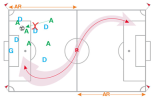
You won't have seen a referee in a professional game run a diagonal like that for at least 10 years, that's not just England, they don't do that in any country now. It initially morphed into the lazy s, a bit like this (not quite right but best I can find. But since then it has become even more extreme and when the attack is down the right wing referees would be expected to be roughly where I've drawn the red X.

1762196674624.png
 
And how does the defender get past you to intercept a pass?
He is in front of you..

Defending players = the team not in possession as opposed to positional naming convention.

Something like the below was always my understanding.

View attachment 8433

That is an old school diagram. The expectation is to be in an advanced position ready for the next danger as opposed to chasing the play around and rigidly sticking to a patrol path like above
 
Would you still think for a newbie referee, trying to keep it simple is, ‘try & run a diagonal, move to the left as play transitions so you are looking in at tackles form the side’.

When you mentor a brand new referee, positioning is usually an issue.

Trying to explain a lazy S, with all the other things you’re trying to learn is too much?

Thoughts?
 
Would you still think for a newbie referee, trying to keep it simple is, ‘try & run a diagonal, move to the left as play transitions so you are looking in at tackles form the side’.

When you mentor a brand new referee, positioning is usually an issue.

Trying to explain a lazy S, with all the other things you’re trying to learn is too much?

Thoughts?
As a newbie, I was always taught to run a figure of 8
 
Would you still think for a newbie referee, trying to keep it simple is, ‘try & run a diagonal, move to the left as play transitions so you are looking in at tackles form the side’.

When you mentor a brand new referee, positioning is usually an issue.

Trying to explain a lazy S, with all the other things you’re trying to learn is too much?

Thoughts?
Most of our teenage learners would not understand "transition" (!) but the idea is sound.
 
You won't have seen a referee in a professional game run a diagonal like that for at least 10 years, that's not just England, they don't do that in any country now. It initially morphed into the lazy s, a bit like this (not quite right but best I can find. But since then it has become even more extreme and when the attack is down the right wing referees would be expected to be roughly where I've drawn the red X.

View attachment 8434
 
Remember people, the goal has always been an still is being in the best possible position to make the correct decision, without interfereing with play or players. All these guildelines are just means to an end and are just that, guidelines.
 
Back
Top