The Ref Stop

IFAB Q and A

Donate to RefChat

Help keep RefChat running, any donation would be appreciated

pankaye

Well-Known Member
Level 5 Referee
I saw this in the Q&A of the LotG 25/26 and i though the answer was interesting.

After a goal kick has been taken by the goalkeeper, the ball touches the referee outside the penalty area, remains on the field of play, and bounces back towards the goal. The goalkeeper handles the ball to prevent it from entering the goal. The referee stops play at this point. What is the correct decision?

answer: dropped ball to the Keeper.

why is not a infringement with an indirect freekick for handling? if the ball hits the referee normally the referee is considered to be part of the playing field (exempt the ball goes into the goal,or a promising attack starts,or possession changes, or the ball changes team possession)

thoughts?

 
The Ref Stop
"Spirit of the law".


This was the reply 3 years ago.
Referees are expected to apply the ‘spirit’ of the Law and in this case a ball that was moving towards the halfway line away from the goal completely changes direction and goes back towards the goal. This can be considered as a new ‘attack’ and, of course, potentially a goal. So football expectation within a common sense application of the ‘spirit’ of the Law is a dropped ball.
 
Another probably more interesting version of this question is if a filed player who is already on a yellow deliberately handles the ball on the goal line to (in his mind) prevent a goal.
 
I saw this in the Q&A of the LotG 25/26 and i though the answer was interesting.

After a goal kick has been taken by the goalkeeper, the ball touches the referee outside the penalty area, remains on the field of play, and bounces back towards the goal. The goalkeeper handles the ball to prevent it from entering the goal. The referee stops play at this point. What is the correct decision?

answer: dropped ball to the Keeper.

why is not a infringement with an indirect freekick for handling? if the ball hits the referee normally the referee is considered to be part of the playing field (exempt the ball goes into the goal,or a promising attack starts,or possession changes, or the ball changes team possession)

thoughts?
The ball going into the goal sounds like a pretty promising attack to me 😂. So, perfectly valid to stop for the drop ball. Technically, I believe the drop ball in this instance should actually be to the defensive team where it hits the referee (despite the question wording) .. but easier / simpler to drop to the keeper
 
Procedure
• If, when play was stopped: • the ball was inside the penalty area, the referee drops it for the defending
team goalkeeper in their penalty area
• the ball was outside the penalty area, the referee drops it for one player of
the team that has or would have gained possession if this can be
determined by the referee; otherwise, it is dropped for one player of the
team that last touched it. The ball is dropped at its position when play was
stopped
 
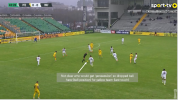
Absolutely @bester. And it’s been clarified by IFAB that, in the case of the ball hitting a match official, the point of that impact is where play is stopped (if, indeed, play needs to be stopped).
 

In the presentation at the top of the page. It’s the video of Yellows v Whites where the referee gets hit by the ball. Given our numerous discussions about how poorly IFAB generally phrase / clarify things, I find it’s always worth digging into their detailed explanations. Absolutely shouldn’t be necessary … but don’t shoot the messenger 😊
 
This image is doing a lot of heavy lifting considering the wording of the law

Why isn't the annotation saying where the ball hit the referee? It's not even pointing to where the ball hit the referee.


1756661076421.png
 
Last edited:
I totally agree. I remained a little unsure even after seeing this presentation, even though the arrow is clearly pointing far more closely to the referee’s position than to the ball position when he blew his whistle. However I then got it clarified through PGMO and it also featured as one of the August law questions for L3 & 4 from the FA.

For what it’s worth, I do think it’s better this way. Whilst there’s inconsistency in the ball drop position vs when play is stopped for other reasons (eg injury), at least there’s complete consistency whenever it hits the referee, rather than random variation depending how long he / she takes to blow the whistle!
 
"Clarification" that The FA's quiz answer was wrong and all drop balls should be dropped from the position of the ball when play is stopped, and not where it struck the referee

I had prior confirmation of this directly from IFAB.

I would note that IFAB still have a Q&A up on the website with the wrong answer.
 
"Clarification" that The FA's quiz answer was wrong and all drop balls should be dropped from the position of the ball when play is stopped, and not where it struck the referee

I had prior confirmation of this directly from IFAB.

I would note that IFAB still have a Q&A up on the website with the wrong answer.
So, pop quiz in that context, where do we drop the ball if it rebounds off the referee and goes in the goal? Given that this is one of only three reasons to actually give the drop ball in these instances.

Remembering that (theoretically at least) the ball could strike the referee either inside or outside the penalty area …. 🤨😊
 
So, pop quiz in that context, where do we drop the ball if it rebounds off the referee and goes in the goal? Given that this is one of only three reasons to actually give the drop ball in these instances.

Remembering that (theoretically at least) the ball could strike the referee either inside or outside the penalty area …. 🤨😊
Assuming you don't blow your whistle until the ball enters the goal, I'd drop it to the keeper. Play is stopped once the ball enters the goal, so closest position of the ball would be 99% over the goal line and therefore within the penalty area.
 
Assuming you don't blow your whistle until the ball enters the goal, I'd drop it to the keeper. Play is stopped once the ball enters the goal, so closest position of the ball would be 99% over the goal line and therefore within the penalty area.
Certainly blowing your whistle before the ball crosses the line (justifying it by the obviously ‘promising attack’) would be a good approach. If the ball has entered the goal, then what you suggest is probably in line with expectations, especially if the ball hit you in the penalty area. Although the more typical restart when the ball has entered the goal without a goal being scored is a goal kick …

But what bugs me is that they’ve updated the drop ball laws and (seemingly) failed to consider and clarify the desired outcome on one of only three reasons for giving a DB after the ball hits a match official 🙄
 
"Spirit of the law".


This was the reply 3 years ago.
Referees are expected to apply the ‘spirit’ of the Law and in this case a ball that was moving towards the halfway line away from the goal completely changes direction and goes back towards the goal. This can be considered as a new ‘attack’ and, of course, potentially a goal. So football expectation within a common sense application of the ‘spirit’ of the Law is a dropped ball.
I had something similar happen to me in an U16 game.

Dropped ball in the area for the keeper. It bounced, he leathered it on the half volley right into the side of my head. Through the stars and cartoon birds circling my head I see the ball heading back towards the goal and the keeper. The keeper clears it again, but I blow mainly to regain a bit of composure.

Drop ball again. "Back into your possession keeper. DO NOT do that again please!"
 
Back
Top